Monday, April 30, 2007
V2a On 17478 @ 1600
Recent improvements in propagation have made V2a's morning (our time) skeds audible here in The Land That Shortwave Forgot. No PSK mode is being used today as of 1630. We seem to be in a pattern where voice is used early in the week, PSK later.

Saturday, April 28, 2007
USCG Seeking Input on HF Services
Here we go again. The frequently threatened HF services from the US Coast Guard are once again up for review. Users are requested to let the CG know how they use the service, and presumably if there is insufficient interest the services will be discontinued.
Reason given is that the equipment has reached the end of its service life, and new stuff costs money.
The following notice was recently published in that US Government catch all called the Federal Register:
And here's the accompanying letter from the Coast Guard:
As we have seen before, the fate of USCG HF broadcasts is now in the hands of the users. The fax/weather/MSI you save will be your own.
Reason given is that the equipment has reached the end of its service life, and new stuff costs money.
The following notice was recently published in that US Government catch all called the Federal Register:
Notice [USCG– 2007– 27656] in Federal Register / Vol. 72, No. 80 / Thursday, April 26, 2007
"High Frequency (HF) Radio Broadcasts of Marine Weather Forecasts and Warnings" (Summary below) for complete text, see: http://www.nws.noaa.gov/om/marine/waisgate.pdf
This is a necessary step in the Coast Guard's justification of
recapitalizing their HF equipment for continued operations.
Details of USCG weather broadcasts via HF radiofacsimile, voice and SITOR may be found at: http://www.nws.noaa.gov/om/marine/home.htm#dissemination
As a service to mariners, please inform potentially affected users of this Notice. It is very important that mariners reply via the Docket Management system or postal mail as called for in the Notice, or their input will not be taken into account.
Federal Register: April 26, 2007 (Volume 72, Number 80)] [Notices] [Page 20863-20865] From the Federal Register Online via GPO Access [wais.access.gpo.gov] [DOCID:fr26ap07-72]
And here's the accompanying letter from the Coast Guard:
DEPARTMENT OF HOMELAND SECURITY
Coast Guard
[USCG-2007-27656]
High Frequency (HF) Radio Broadcasts of Marine Weather Forecasts and Warnings
AGENCY: Coast Guard, DHS.
ACTION: Notice; request for public comments.
-----------------------------------------------------------------------
SUMMARY: The Coast Guard is soliciting public comment on the need to continue providing high frequency (HF) radio broadcasts of weather forecasts and warnings. Public comment is necessary in order to assess the demand for the HF radio broadcasts of weather forecasts in each of three forms: (1) Radiofacsimile; (2) voice; and, (3) Simplex Teletype Over Radio (SITOR), also known as Narrow Band Direct Printing (NBDP). The infrastructure necessary to provide these services has exceeded its life expectancy; the equipment is no longer manufactured, repairs are difficult to accomplish, and spare parts generally are not available. Because of the very significant costs involved to continue these specific HF radio services, the Coast Guard requires information on the extent to which these services are used by the public and what alternative services are being used or are available to obtain weather forecasts and warnings.
DATES: Comments and related material must reach the Docket Management Facility on or before August 24, 2007.
for complete text see a copy of the Notice at:
http://www.nws.noaa.gov/om/marine/waisgate.pdf
As we have seen before, the fate of USCG HF broadcasts is now in the hands of the users. The fax/weather/MSI you save will be your own.
Thursday, April 26, 2007
Solar Flux Is Up
After a dismal couple of weeks, solar flux has jumped to 81, with an immediate effect on HF propagation. At 0345 UTC, Hawaii is still S9 on 20 meters.
SK01 up at 1701 on 17436
Signal is weak here in The Noise Capital of the World, but it's definitely in there.
Mode sounds like PSK220F again.
Mode sounds like PSK220F again.
Thursday, April 19, 2007
SK01 up at 1721 in PSK220F
After being absent for a few days, SK01 is in progress right now with cut numbers (letters) and regular figures (numbers) on 17436.0 in PSK220F.
Signal is fading, but strong on peaks, and Multipsk decodes it just fine. Look for a buzzy noise centered around 1000 Hz. Speed is 220 baud, much faster than PSK31.
Signal is fading, but strong on peaks, and Multipsk decodes it just fine. Look for a buzzy noise centered around 1000 Hz. Speed is 220 baud, much faster than PSK31.
Sunday, April 15, 2007
Northwood UK Fax Via DX-Tuners
DX-Tuners is a global network of receivers tunable by the Internet. A couple of these are free, then you get a lot more by subscribing at different levels. A few of these are "DX" receivers, with good antennas and audio of sufficient quality to achieve good decode of many digital modes. HF weather FAX, for example, is a snap. [I know, FAX is analog, but you get the point.]
Here's an especially good surface weather chart from the UK Royal Navy, received on 8038 kHz USB dial reading on a large wire antenna in Alma, Sweden, then sent over the net to my computer here in The Land That Shortwave Forgot:

Here's an especially good surface weather chart from the UK Royal Navy, received on 8038 kHz USB dial reading on a large wire antenna in Alma, Sweden, then sent over the net to my computer here in The Land That Shortwave Forgot:

Friday, April 13, 2007
New Drippy Pirate Beacon
A pirate beacon on 6626.0 kHz (dial freq in USB mode) has been reported. It produces a low chirping noise approximately 3 times per second. It is said to sound like a quickly dripping faucet.
The beacon is audible here right now, way down in the noise that has been S5 ever since yesterday's wind storm. Propagation points to the usual SW US location, perhaps the California or Arizona desert.
UPDATE 15 Apr: All bets are off on this signal. It's being heard in places where propagation would simply not happen from the SW US at that time of day on 6 Mhz. One person suggested it's a Link-11 that is so weak all you hear is the pong, pong, pong tone of the bursts. However, most Link-11 has different burst lengths, and this one's regular.
Gander Takes Over Canadian NAT-D Control
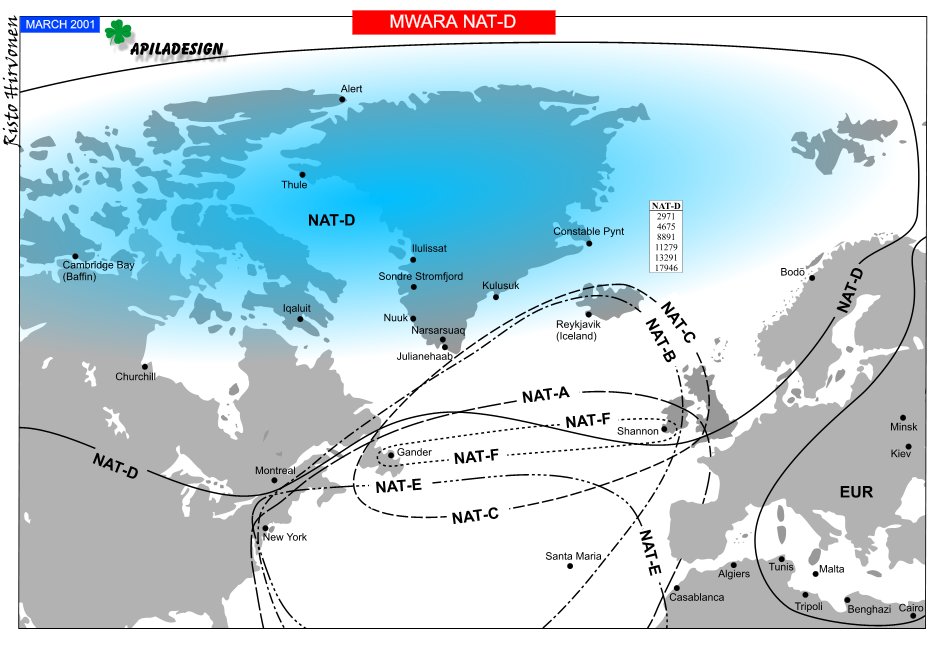
NAT-D is a North Atlantic Major World Air Route Area (MWARA) net for aircraft flying over the Arctic regions. Its frequencies are 2971, 4675, 8891, 11279, and 13291 kHz USB. A good map appears at Arcticpeak.com.
Effective March 15, NAV Canada, the agency responsible for Canadian communication on this net, has dropped HF services from Cambridge Bay and Iqaluit. It was decided that operation could be more efficient combining everything in a master station at Gander. Aircraft are being told that Cambridge Bay and Iqaluit must now be called on VHF.
Here's the text:
ICAO High Frequencies and Remote Communications Outlet
North Bay, Ontario
Change of Ground Station
NAV CANADA, the country’s provider of air navigation services, recently reviewed the provision of ICAO High Frequencies (HF) and Remote Communications Outlets (RCO) provided by the North Bay Flight Information Centre (FIC). The review concluded that the ICAO 4 HF frequencies (2971, 4675, 8891, 11279) at Cambridge Bay and Iqaluit and the 1 RCO frequency (126.9 MHz) at Iqaluit could be provided more efficiently from the Gander International Flight Service Station (IFSS).
Accordingly, Gander Radio will serve as the Ground Station and provide the ICAO 4 HF frequency monitoring at Cambridge Bay and 1 RCO (126.9 MHz) and 4 HF coverage at Iqaluit.
This change will take effect March 15th, 2007 at 09:01 Coordinated Universal Time (UTC). Amendments will be made to the appropriate aeronautical publications.
For further information, please contact:
Marcel Pinon
Manager, Level of Service and Aeronautical Studies – East
NAV CANADA
77 Metcalfe Street
Ottawa, ON
K1P 5L6
Phone: (613) 563-5630
Fax: (613) 563-5602
pinonm@navcanada.ca
Sunday, April 08, 2007
Bad Dream
I keep trying to like Digital Radio Mondiale. A couple of broadcasts are pretty loud into The Land That Shortwave Forgot aka California. They sound really cool. They don't use IBOC, so there's no analog signal at all. It sounds like the old SELSCAN tones they used to use on the COTHEN net, only more so.
Good ute DXers refuse to be told they cannot extract intelligence from every weird noise out there, so of course I went looking to see what I'd need to hear the digital quality audio on my own little short wave radio. I found out that what I'd need is to modify the radio to send a 12 MHz IF directly to the computer. No thanks. I like my NRD-545 the way it is. Thank you.
If it is true that the implementation of DRM that the industry intends to use is completely incompatible, and there will never be a US $29.95 converter board for analog receivers that can be installed with two wires and an AA battery, we have a problem. Every short wave receiver in the world may someday be useless. This bodes ill for the future of the medium, since the installed receiver base in places like Africa is all that keeps it alive. People who use wind-up radios because they cannot afford batteries are not going to afford new radios either. Bye bye shortwave broadcasting.
And then, of course, there is digital SSTV.
I heard someone complaining on the digital SSTV frequency that he can never decode the pictures. No matter how loud the signal is, he misses segments and everything goes blooey. They asked him what program he was using, and laughed when it wasn't EasyPAL Lite, since that's all they ever use.
Since EasyPAL Lite seems to have a new version out every couple of weeks, I downloaded today's beta (literally dated 4/8), and started it up. Crash-o-rama. I guess it's improving, though. It doesn't hang the computer any more. It just tries to write to nonexistent addresses, and goes quietly.
Sometimes, I am told, things improve if you turn off hyperthreading. Unfortunately, I am very much of the old school, and will go to my grave convinced that good programmers do not ask their users to make BIOS changes. I guess that leaves Digtrx and HamDRM as the working programs, and I will have to be content with sending files to myself.
C'est le guerre.
Friday, April 06, 2007
V2a In Voice Today
At 1711 UTC, the Cuban transmission remains standard voice V2a, on 17436.0 kHz AM. The signal is fading badly in California, but I imagine I should be glad to hear it at all. Some kind of weird QRM or ???? keeps cutting in and out.
Listening...
Listening...
Thursday, April 05, 2007
Cuban PSK Tries New Mode (PSK220F)
On April 5, the 1600 and 1700 UTC schedules of the new Cuban numbers using phase-shift keying gave us yet another surprise. The transmissions were in a relatively unknown mode named PSK220F, not the more normal PSK31 used by amateurs. The main difference is that PSK220F is much faster. As a result, the transmission was in both ordinary numbers and the "cut" numbers where letters are substituted.
The frequency used at 1600 UTC was 17478.0 kHz, and at 1700 UTC it was 17436.0 kHz.
A brief transmission in computer generated voice using the normal V2 mode preceded these PSK220F skeds, as if to let receiving stations know that something new was going to happen. Perhaps this other callup was a coded announcement.
Most amateur freeware does not decode PSK220F. One that I know does is the latest version (4.2) of MultiPSK. This is an amazing program for free. Don't let the old-school user interface fool you. It does a creditable job on a huge number of modes, with only a few of its advanced features disabled until it's paid for. MultiPSK is available at a couple of sites. The main site is F6CTE, with a US mirror at N8KBR, and UK here.
Saturday, March 24, 2007
Updating PC-HFDL for New System Tables
We've had some confusion over how to copy the new pchfdl.dat file into PC-HFDL's configuration folder to update its frequency list (ARINC System Table #31 / 0x001F hex).
The file linked from this blog is identical to the one available on the PC-HFDL Yahoo! group. That's where I got it. I thank this group for making it available.
Not everyone can access the files sections of Yahoo! groups, since a Yahoo! login is needed, while a mailing list can simply be read in e-mail. Therefore I have been posting copies of these files to the Utility World web site.
Here is the procedure for installing pchfdl.dat as the new frequency file for this excellent program. This is how I have done it for several system table changes now, and it has worked every time:
How to update the PC-HFDL System Table with pchfdl.dat:
Good listening!
The file linked from this blog is identical to the one available on the PC-HFDL Yahoo! group. That's where I got it. I thank this group for making it available.
Not everyone can access the files sections of Yahoo! groups, since a Yahoo! login is needed, while a mailing list can simply be read in e-mail. Therefore I have been posting copies of these files to the Utility World web site.
Here is the procedure for installing pchfdl.dat as the new frequency file for this excellent program. This is how I have done it for several system table changes now, and it has worked every time:
How to update the PC-HFDL System Table with pchfdl.dat:
Background:
This file updates the internal system table used by Charles Brain's commercial version of PC-HFDL, a program for the Wintel PC which decodes ARINC's High Frequency Data Link signals.
The HFDL system stores its frequencies in a common list called the System Table, which is changed every few months as HF propagation conditions change with the seasons. The system table number, which is transmitted by the ground stations, is incremented by one.
Ground stations transmit the new list until everyone has it, and no aircraft has a table number mismatch. This usually takes only a few days. PC-HFDL cleverly grabs these transmissions to update itself, and stores them in a file called pchfdl.dat. When PC-HFDL detects a new version of the System Table, it automatically updates this file.
An issue exists where, if PC-HFDL is not running or there is no clear reception at the right times, it will not receive the transmissions needed to update this file. This causes the display of frequencies in the squitter screen to change back to numbers rather than kilohertz, making the program much harder to use. Therefore, the user is told how to update this file manually.
Procedure:
1. Get a copy of a pchfdl.dat file that someone else has made with the program since the new frequencies were transmitted. There is usually one on the Yahoo! HFDL group within a few days, which I change on my site at the same time. This file should be treated as a binary, whether or not it is. If it is read on the screen, it will look more or less like total nonsense, but the program knows what to do with it. Download the file to your disk by right-clicking on the link, then choosing "save target as," "save link as," etc. Make sure it downloads to the desktop or some other place where you can find it quickly.
2. IMPORTANT! Close PC-HFDL before going any farther!!! You won't break anything if you don't, but the frequencies won't update.
3. Find the directory that PC-HFDL runs from. This is usually C:\Program Files\PC-HFDL. Change to this as the active directory.
4. In this directory, there should be a subfolder named configs. Change to this as the active directory.
5. In configs, find a file named pchfdl.dat. It should be around 24K. Rename this file something like oldpchfdl.dat, or pchfdlnn.dat, where nn is the number of the former system table.
6. Copy the pchfdl.dat you have just downloaded to this subfolder. It should now contain your old data file, your new pchfdl.dat, and three other files. It's safe to open these others, but don't change them! One of these, systable.txt, is a human-readable version of the System Table that is written out once pchfdl.dat is processed. Another, pchfdl.txt, lists the ground stations. The third, pchfdl.ini, is the binary initialization file that stores the previously used configuration of the program.
7. Go back to the desktop or start menu, and run PC-HFDL. Find a nice loud ground station with the squitters and click the box. The numbers should once again be replaced by frequencies.
Good listening!
Monday, March 19, 2007
New HFDL Frequency Table 31 is current
I got busy for three days and look what happened. ARINC changed its HFDL System Table of frequencies used for its GlobalLink system.
This is done periodically, usually when the season changes. The new System Table is number 31, or 1F in hexadecimal.
The pchfdl.dat file on this column's web site has been updated. Close down PC-HFDL, then find the directory it runs from. Change to the configuration subdirectory, find pcfhdl.dat, and rename it. Copy in the new file, then start the program. The numbers should change to frequencies again.
I have done this procedure on my own computer, and the file works. Thanks to the HFDL Yahoo! group for putting this up.
Meanwhile, here's what's being transmitted in New York's squitters at 2218 UTC. Obviously other times of day are different:
SAN FRANCISCO - CALIFORNIA UTC
8927 KHz 5508 KHz
MOLOKAI - HAWAII UTC
21937 KHz 13276 KHz 11312 KHz
REYKJAVICK - ICELAND UTC
8977 KHz 6712 KHz 5720 KHz
RIVERHEAD - NEW YORK UTC
11387 KHz 6661 KHz
AUCKLAND - NEW ZEALAND UTC
13351 KHz 6535 KHz
HAT YAI - THAILAND UTC
10066 KHz 5655 KHz
SHANNON - IRELAND UTC
8843 KHz 6532 KHz
JOHANNESBURG - SOUTH AFRICA UTC
8834 KHz 4681 KHz
BARROW - ALASKA UTC
11354 KHz 6646 KHz
KRASNOYARSK - RUSSIA UTC
6596 KHz 5622 KHz
AL MUHARRAQ - BAHRAIN UTC
8885 KHz 5544 KHz
AGANA - GUAM UTC
13312 KHz 11306 KHz
CANARIAS - SPAIN UTC
11348 KHz 6529 KHz
Thursday, March 15, 2007
Give Us This Day Our Daily SK01
17436 PSK31 in progress at 1708 UTC. Began like clockwork at 1700 with 10x 11111, missed some of callup due to operator stupidity (mine, not theirs), middle message is NNTWI, 3rd GTWGI. The signal is strong s7-9 but with frequent deep fades. The audio is way overdriven for PSK31 with heavy distortion causing missed characters at times.
UPDATE 1751 UTC: The signal cut abruptly without the usual 10x 22222 at 1730, back up at 1733 in mid-message, still going at 1052, much later than normal.
UPDATE 1751 UTC: The signal cut abruptly without the usual 10x 22222 at 1730, back up at 1733 in mid-message, still going at 1052, much later than normal.
Wednesday, March 14, 2007
SK01 Makes Both Skeds
17436.0 kHz at 1700, started promptly in PSK31 with the 10x 11111 starting signal, then callup and message in modified M8a format, using the letters. Still in progress at 1720.
UPDATE 1732 UTC: SK01 abruptly changed to V2a at 1732, finished transmission in voice, "Final, final" at 1744 and gone.
Digipan has trouble with very long PSK transmissions, being designed for short amateur exchanges. Will try it with SkySweeper next time.
UPDATE 1732 UTC: SK01 abruptly changed to V2a at 1732, finished transmission in voice, "Final, final" at 1744 and gone.
Digipan has trouble with very long PSK transmissions, being designed for short amateur exchanges. Will try it with SkySweeper next time.
Cuban PSK 3/14
17478 5-figure group message in progress right now at 1605 UTC, weak into California. Appears to be the modified V2a sked.
Tuesday, March 13, 2007
Cuban PSK Continues
Today, two schedules.
1600 UTC 17478 kHz, modified V2a format. Repeats group 11111 at message start, 22222 at end. Three messages.
1700 UTC 17436 kHz, modified M8a format with the letters!!!! These are essentally meaningless in a Varicode direct printing mode, where they save a few bits per character, as opposed to cut-number Morse, where they save a huge amount of time. Presumably, Cuban spies and/or their software are used to them.
Both times in PSK31 mode, and audible worldwide. The ENIGMA 2000 designator is SK01. Apparently the PSK is here to stay.
Sunday, March 11, 2007
Digital SSTV Saga Ends
After another day of watching the grass grow, I have decided to go back to utility and leave the digital SSTV experimenters to it. I received a couple more nice pictures, with missing segments, from an amateur in Mexico, who was sending dramatic pictures of women in body paint obviously applied as some sort of art show. These were great stuff, and make me want to look around Google Images for more examples of same.
To see real content is, of course, is rather refreshing, considering the one-note samba that is American analog SSTV. You have the guy that wants us to get Jesus, the one who never met an airplane photo he didn't like, and the one with "YL" in his call who sends pictures of, uh, YLs in rather scanty clothing.
Come to think of it, that third guy can keep on with what he's doing. That scanty clothing thing is fine with me.
Must... think... about... radio... .
Digital SSTV, of course, is not a very good name for it. Digital file transfer would be better, since that's what's going on, and the data could really be just about anything. That's the advantage and disadvantage.
The advantage is that, if everything is received, you have the same file that left the transmitting station, not a grungy decode of a scan of its contents. The disadvantage is that Digital Radio Mondiale in its present state is an audio broadcast mode, and better ways exist to transfer files. There is no repeat procedure for missing information transfer units (packets, segments, whatever), because in audio broadcasting there does not need to be. Segments failing the CRC check are simply discarded, and you don't hear that part.
Of course, the receiving station of a file transfer can always ask for, and get, the missed segments. They've sort of automated this process, with bad segments being logged and requested manually by clicking a button for a "BSR" (Bad Segment Resend?) transmission. This is fine, but obviously the retransmission will probably not be the same segments that people listening on-channel missed. For that, you need redundancy, like in FEC mode. In digital SSTV, real redundancy consists of transmitting the whole file more than once, but that means very long transfer times.
There is also the problem that DRM might not be the best mode for amateur equipment, which at least in the US is not allowed to exceed 1500 watts peak envelope output power. DRM's peak to average ratio is awesome, something on the order of 10 dB. In amateur service, this means that your typical 1500 watt PEP linear cranked to the max will be reading about 120-130 average watts at "full legal output."
Somehow I doubt that we will be seeing whole screens of Internet SSTV widgets showing reception worldwide, as we've had in the analog mode for some time now. (A great one is Worldwide SSTV Cams.)
Now, back to utilities...
Friday, March 09, 2007


MY FIRST PICTURES!!!!!!
Two days of sitting at the receiver have been rewarded. At 2226 UTC today, W9CY sent a file named UP7.jp2. Amazingly, something appeared in my rx window. I darn near spit my coffee all over the keyboard.
Here is NV6H Digital SSTV First Light:

I wonder what it is. Looks a bit like a Chrysler Air Raid Siren. I think there was something on the orderwire about its being in Hawaii. I missed about 20 segments. Obviously the Irfan View partial feature is working. All in all, not much worse than most of the analog SSTV ends up looking in California on the typical wire antennas used for ute DX.
A mere nine minutes later, the miracle repeated itself! Another picture appeared in my rx window! It's called dq2.jp2. I only lost 11 segments this time. Here's the awesome result, as seen on my very own computer:

This time I know what it is. Thanks to W9CY on the orderwire, I know that it is a Dairy Queen in Illinois!
Conditions seem quite good today. There is no telling what further miracles of human communication await.
UPDATE 2313UTC:
OH MY GOD! There is an AMERICAN EAGLE in my WATERFALL!
The possibilities for conceptual art are endless...........
Subscribe to:
Posts (Atom)